

Why do some people die at 80 and feel like they’ve lived 30 years?
And why do others die at 80 and feel like they’ve lived 300 years?
That’s what this essay is about.
But first, let’s go back in time to 1933 and meet a boy called Henry.
1.
In 1933, Henry Molaison is 7 years old, and is playing outside on the streets of Connecticut.
A man riding a bicycle doesn’t see Henry, cycles into him and knocks him unconscious.
Henry is never quite the same again.
It starts with minor seizures, and by the age of 27, Henry is having twenty epileptic fits per day.
Desperate to cure his crippling condition, he volunteers for experimental brain surgery. As Henry wakes up from the operation, life delivers him some good news, bad news, and awful news.
The good news is that the surgery has largely fixed his crippling epilepsy.
The bad news is that he won’t remember the good news, because of the awful news.
The awful news is that the surgery has destroyed his ability to form new memories.
For the next 55 years of his life until Henry dies at 82, every day, every hour, and every minute of his life is forgotten.
His psychiatrist visits him daily and gets to know him well over the years. Whereas Henry meets his psychiatrist for the first time each day.
The most tragic detail of Henry’s life was found in his mirror: Henry would get out of bed, go to the bathroom, look in the mirror and be confused at why his reflection looked so old.
The problem with amnesia is not only do you forget, you forget that you forget.
If Henry forgot every minute of his life, did he have a life?
Henry had a rare condition — but it’s not rare to forget large portions of your life. It’s one of the most common human experiences for time to disappear as you age.
Let’s call it Henry’s Mirror. When you see an older face staring back at you in the mirror, and wonder: Where did the time go?
2.
One of the explanations given of why time speeds up as we age is Janet’s law.
When you’re 5 years old, a year is 20% of your life. And when you’re 50 years old, a year is 2% of your life. Janet’s law states that you experienced roughly half of your perceived life by 20 years old.
Or to put it another way: The summer for a 5 year old feels as long as the 10 years from 40 to 50 years old.
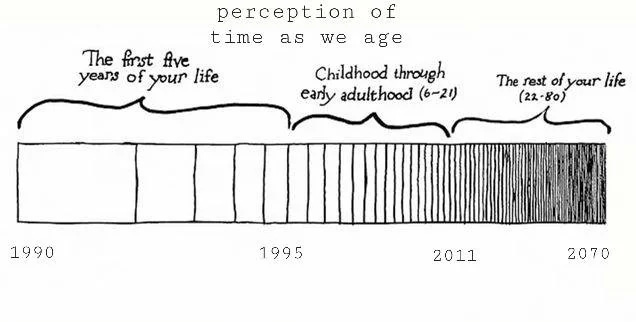
It’s more useful to view time in three dimensions:
Clock time - How time ticks on a clock.
Experience time - How time feels in the moment.
Memory time - How much time you remember.
One hour in clock time is always one hour on clock time — but it’s not always one hour in experience or memory time.
Your flight gets delayed by one hour, and it feels like five hours staring at the departures board, yet you struggle to remember it weeks later.
Or that hour long sunrise walk laughing with friends speeds by. But one year later you remember that sixty minutes more clearly than the entire month of April where you stared at your laptop.
In Henry’s 82 years, he had lots of clock time. 2.6 billion seconds, 4,278 weeks and 29,951 sunrises. But Henry’s life flew by because it was 0 minutes in memory time.
When people say time is moving quickly, what they are actually saying is they don’t remember where the time went.
Memory is why the first 18 years of your life feel so slow in hindsight. New experiences are encoded into memory. The first day at school, the first time you drove a car, your first kiss or first heartbreak.
It’s why every married couple can remember their first date — but few can remember their 37th date, unless it was novel.
If you don’t break this pattern, soon you’ll catch an older face in the mirror and wonder: Where did the time go?
3.
If you were to compress thousands of scientific journals on increasing human life span, you get the following Three Laws For Living A Long Life:
1. Exercise
2. Don’t smoke
3. Sleep 7-8 hours per night
But in Chapter 7 On The Shortness Of Life, Seneca said: “You must not think a man has lived long because he has white hair and wrinkles: he has not lived long, just existed long.”
So what if you want to exist AND live longer?
Unlike Henry, we have agency over this.
Here’s the Three Laws of Remembering Your Life:
Law 1 - Seek Novelty
How many days do you remember from last year?
The typical answer is about 10-20 of the 365 days.
That’s about 95-98% of the year lost to Henry’s Mirror.
Look at the days you remember. Stare into their soul. What do they have in common? You’ll notice some novel event happened where you broke out of routine and that day got encoded into memory.
In the micro, never let a day go by where you don’t do something novel — no matter how small. It could be a new route to work, a conversation with a stranger, a book opened at random.
In the macro, create at least one genuinely novel day every fourteen days — a day so different to your past thirteen days that future-you will be able to find it when you go looking for it.
Law 2 - Optimise for the best story
How many social media posts do you remember from yesterday?
The average person sees 300 novel posts in a single scroll. If novelty is the only variable for memory, those posts should be unforgettable. And yet hours later, they’re gone.
Now think of a great movie you watched years ago. You can probably recall the plot, the turning points, and maybe even specific lines of dialogue. Why does one great movie from years ago outlast tens of thousands of social media posts you’ve scrolled past since?
Social media is a random series of events, no cause and effect, no escalation, no resolution. A great story is a designed series of events with a clear structure that taps into our emotions. That’s why we remember it.
This is also why university tends to feel longer in memory than other periods of life. It’s split into multiple years (parts) and each year is split into semesters (chapters). There’s a clear progression of the plot towards the finale.
If your life feels like a great story, you’ll remember more of your life. If your life feels like a boring story or a random social media scroll, you’ll forget your life.
A good rule of thumb when you’re making a decision is to ask yourself: What makes the better story?
Even if the decision goes wrong, time will slow down as your plot thickens. And as Entrepreneur Amjad Masad says: “You’ll at least be fun at dinner parties”
Sit down and look at your life story so far. If you were watching a movie, what would the hero do next?
Do that, and you’ll remember more of your life.
As Dostoevsky said in White Nights: “But how can you live and have no story to tell?”
Law 3 - Marvel at the smallest details
You can’t maximise novelty and your life’s plot every single second of the day.
You will wake up in the same bed as your partner most days, take your children to school most days and you walk the dog most days.
When you’re doing repetitive habitual events, squint and marvel at the small details so your brain slows down the perception of time.
When you look at your partner, can you spot a freckle on their face you’ve never consciously noticed? When you look at your child, try to see a new depth to their eye colour. When you listen to your favourite song, is there an instrument you can notice that you’ve never heard before?
In Japanese culture, this idea is called Ichigo Ichie, that every moment, even when it feels repetitive, is unique and will never be repeated again.
When you’re at dinner with old friends, notice how it’s the first time you’re all this exact age, in this exact month, with this exact weather, eating this exact meal — never to be repeated like this ever again in the history of the universe.
Your morning coffee is never the same coffee. The temperature is slightly different, the first sip lands differently, your mood is different, the light comes through the window differently. Look for those small marvellous differences.
One of the best ways to notice the small marvellous details is to view today through the lens of your 85 year old self in a care home. What are the small details they’d notice if they could go back in time to this moment?
Do not go gentle into the good night of forgetting your life. Rage, rage against the dying of the light by marvelling at the impermanent details.
4.
The good news is that you’re not a passive victim of time like Henry. You don’t have to forget your life.
If you live your life on autopilot, you may die at 80, but feel like you died at 30.
If you take agency over your life, you may die at 80, but feel like you died at 300.
If you seek novelty, create stories and marvel at the small details, when you see an older face staring back at you in the mirror, you won’t wonder: Where did the time go? You’ll say: “Oh, I’ve got so many stories to tell.”
If you enjoyed this, I’m putting together a list called anti-slop — the list of the best 50 resources — books, movies, podcasts I’ve consumed. Get it by putting in your email below.
Love it! I'm a 65 year old with 3 grandkids. I started sending out a monthly newsletter to family on life that month with emphasis on grandkids. I remember easily 100x what I would have otherwise. One of my better decisions was to start 6 years ago. I wish I had started earlier.
Great ! makes me wonder.. Honest question after reading this: how much of "where did the time go?" is really a memory problem vs how much is an avoidance problem?
Because when I look back, the years ( decaades) I remember least aren't the ones that lacked novelty.
They're the ones where I was dodging a decision I didn't want to face.
New job, hard conversation, divorce, whatever — I just… didn't.
And the months around that? Gone.
I'm starting to think autopilot isn't a failure of attention. It's a way to not feel the discomfort of being stuck.
The mirror doesn't just ask "where did the time go?" It asks "what was I avoiding while it passed?"