

I’m going to tell you about the single most powerful idea I’ve found for solving problems.
But first, let me tell you about my morning routine.
1.
Here’s how I started my day this morning:
1. Got out of bed
2. Walked to the bathroom
3. Brushed my teeth
4. Had a hot shower
You might not be impressed, but if the ghosts of kings, queens and emperors could see me, their jaws would drop in awe.
The most powerful man in the world and ruler of Rome, Emperor Augustus, slept on a sack of straw.
Marie Antoinette, the future queen of France, lived in an era where people threw their bathroom visits out of the window. As she strolled around the palace of Versailles, someone emptied their bathroom visit from the top floor and drenched Marie.
Speaking of Queens, Queen Elizabeth I's teeth were black from decay. The Queen was convinced that cleaning them with sugar would help, but it only accelerated her rotting mouth.
Genghis Khan and Julius Caesar never experienced a hot shower. Hot showers as we know them today weren’t invented until the 1860s, and didn’t become common for the average person until the ~1960s.
I forgot about air conditioning because it silently works for me 24-7: In 1881, as President Garfield lay dying, engineers had to gather over half a million pounds of ice and blow air over the ice in an attempt to keep the president’s room cool.
I started my day dancing on the graves of dead problems that dead people thought could never die.
Dead problem = Problem that’s been solved
Alive problem = Problem yet to be solved
2.
Take a guess: How many years did it take for human beings to create fire, build shelter, and hunt with spears?
About 2.2 million years. 1.5 million years to master fire, 500,000 more years to build shelter. Another 200,000 years before we sharpened a spear.
I used to think humanity progressed like the red line, but it actually looked more like the green line.
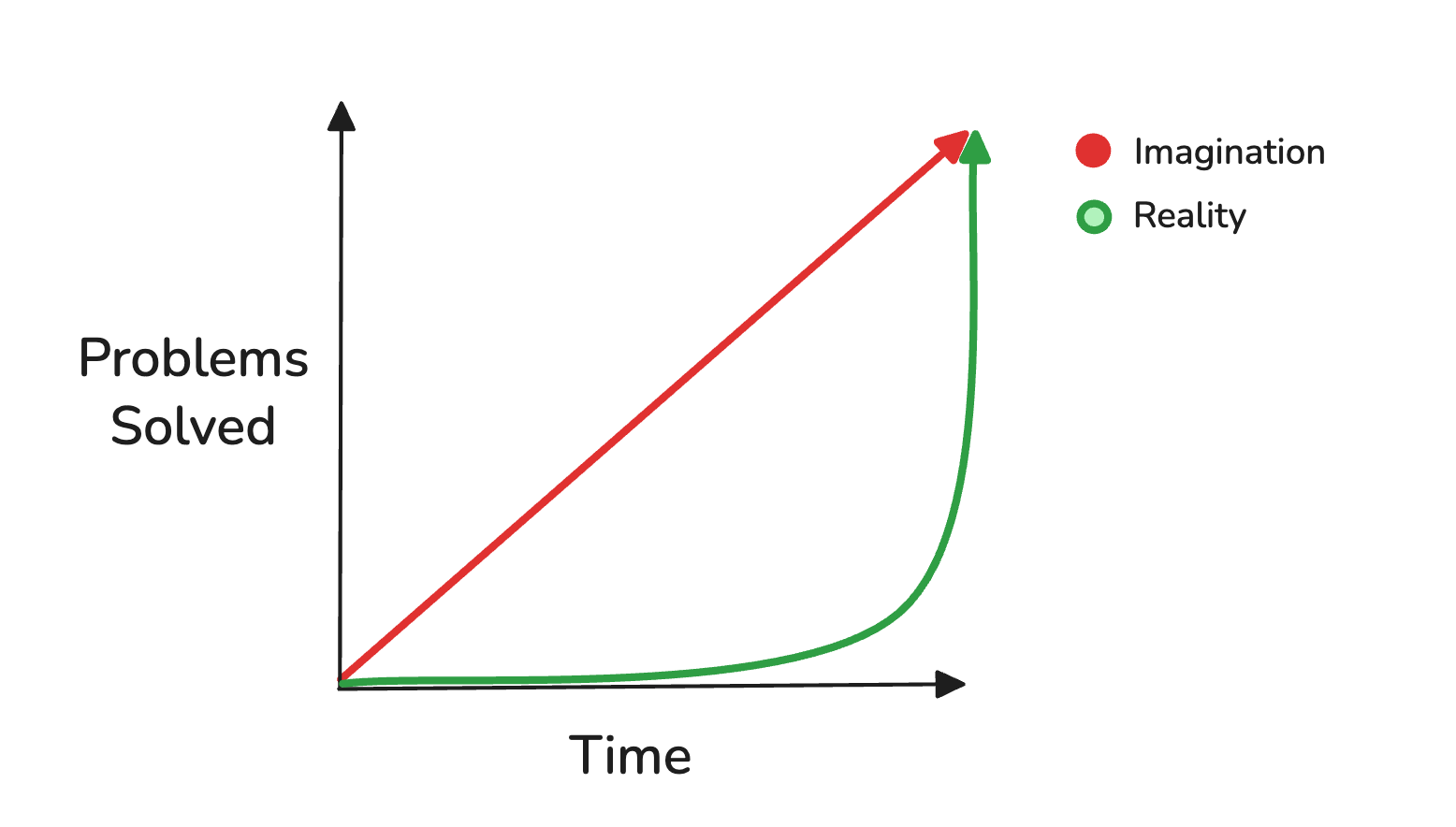
Suddenly in the 16th century, a boom happened. More problems started getting solved in one year than past humans did in hundreds of thousands of years. It’s known today as The Enlightenment.
If you imagine the entire history of humanity as one year, this boom only happened at 11:40 PM on December 31st, just twenty minutes ago.
For most of human history, when humans faced problems they:
1. Assumed they were unsolvable
2. Assumed authority had the answers
If people questioned 1 or 2, they risked isolation like Galileo, who claimed the Earth orbits the sun, confined to house arrest for nine years. Or like Giordano Bruno, who declared the universe was infinite, taken to the town square and burned alive.
So what changed?
Human beings began to solve the ultimate problem, the giga problem, the problem of all problems: They solved the problem of how problems are solved.
3.
In 1934, Austrian philosopher Karl Popper published The Logic of Scientific Discovery. It contains the best explanation I’ve found of solving the problem of how problems are solved:
Notice a problem - You notice something doesn’t work or conflicts with what you expected.
Create a guess - An explanation that is specific and risky.
Test your guess - Don’t look to confirm your guess, look to test it with:
A. Logic test - Look to spot contradictions.
B. Reality test - Run an experiment.Eliminate errors - If your guess fails the tests, improve it or discard it.
Repeat - You’re back at step 1 making a new guess with the lessons learned. Or you’ve solved it, and moved onto a new bigger and better problem.
I simplify Popper’s ideas into something I can loop in my head:
Guess, Test, Correct.
I call it the boom loop:
Make a guess
Run a test
Correct errors
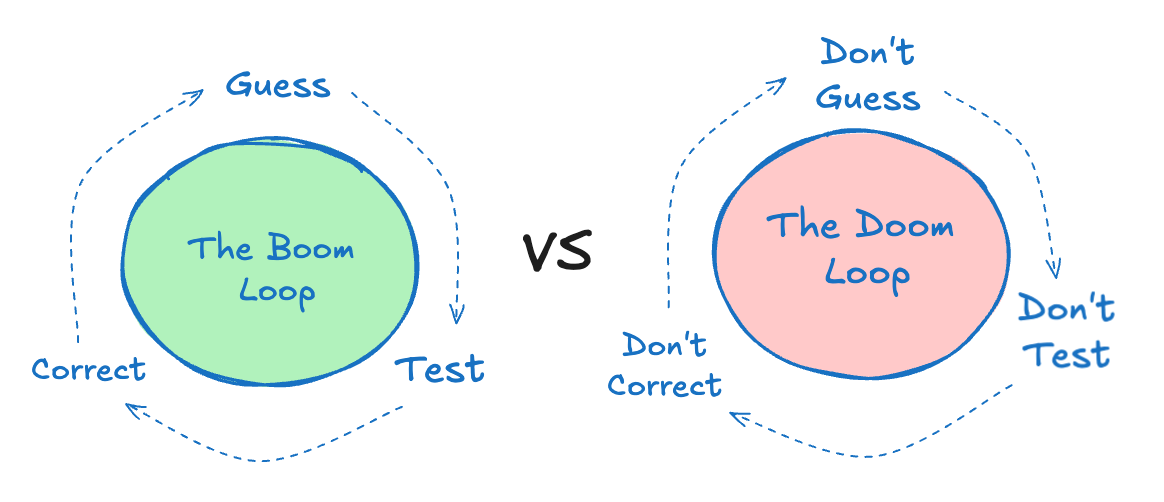
Pick a problem in your life right now. Have you made a guess about how to solve it? Have you tested your guess with logic and experiments? Have you eliminated the errors that happened? And how many times have you repeated the boom loop?
Whenever you’re stuck on a problem without progress, you’re in the doom loop.
4.
The boom loop is delicate. Remove just one variable and you end up in the doom loop.
If you’re not making progress on a problem, it’s because you either:
1. Didn’t guess
2. Didn’t test
3. Didn’t correct
Let’s go back and look at somebody stuck in the doom loop, Queen Elizabeth and her rotting teeth.
1. Queen Elizabeth makes a guess
Sugar is expensive, so it must be good for my teeth.
2. Queen Elizabeth tests her guess
A. Logic test - If her majesty looked for evidence against her guess rather than evidence for her guess, she would have seen her peasants who couldn’t afford sugar had better teeth than the wealthy aristocrats who could.
B. Reality test - Queen Elizabeth went ahead and rubbed sugar on her teeth.
3. Queen Elizabeth didn’t error correct
She had an error, her teeth were getting blacker, but she kept rubbing sugar on her decaying mouth.
The Queen denied and hid reality: When foreign ambassadors came to her Palace, she would hold a cloth in front of her mouth to hide her teeth when she spoke.
A German visitor, Paul Hentzner, wrote in his diary after meeting the Queen in 1598: “Her teeth were black. A defect the English seem subject to from their too great use of sugar."
People around Queen Elizabeth could see her doom loop, but who wants to error correct a Queen?
5.
Imagine the outside world as the ocean. And now imagine your head as one giant bucket. Reality is pouring into your senses and the words your reading soak up from the the screen into your eyes and then into your brain.
But the bucket just had a leak.
If you go back to the 3rd sentence and read it slowly, you’ll see I wrote the twice, but ~90% of readers’ minds skip over this.
If you did notice the double the, well done, but now notice the sensation of your feet. Why has the sensation of your feet only just appeared? Where have your feet been? Did you have no feet until you paid attention to them?
Your mind is not a bucket passively soaking in information. Your mind is a guessing machine.
Imagine your great-great-grandparents time travelling from 100 years ago to stand opposite you now. What problems have humans solved that would blow their mind?
Every single one of those problems was killed by a guess. Guessing is the mother of all solutions.
The hot shower, the air conditioning, the mattress, the toothpaste, the toilet — it all started as a guess.
You learnt to walk, talk and read these words I type as a guess.
There was no textbook. It was a guess, the guesses were tested against reality, errors happened, and the errors were corrected by new guesses.
And at some point… Boom. Problem solved.
Now, are you going to make new guesses about your problems? Are you going to test your guesses? And are you going to error correct those guesses?
Every solution starts with a guess.
Now who would’ve guessed that.
I love your decision to use headers with numbers, but not include any title. It forces the reader (me) to simply read each section, one after the other, and focus on the actual content, not the summarized title.
I often read headlines and then simply start looking for the stuff in the headline within the body of the document/article/blogpost. This is refreshing.
(Also enjoying the content as I am reading still)
So much of what I read feels like recycled thoughts - this genuinely made me sit up and think afresh and in a way I just would not have done save for this piece. Really fun and thought provoking- thanks so much. I’ll be grateful each morning after this!